
Name the Evil Philosopher
Let's play a game.
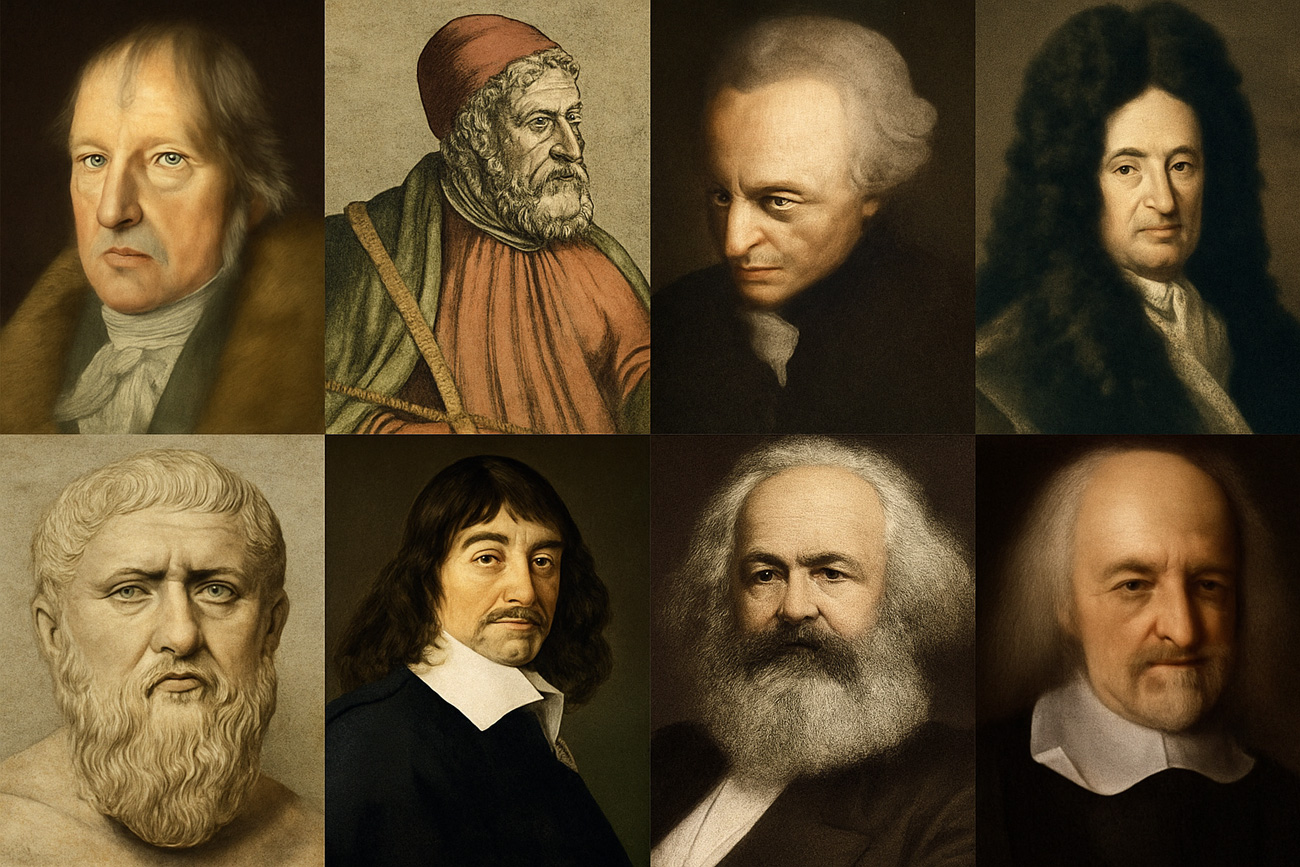
Let’s play a game that I invented. I call it “Name the Evil Philosopher”.
Evil Philosopher #1
This evil philosopher proposed the creation of a supposedly utopian republic, but although he described it like a utopia, it was actually a totalitarian republic ruled by a king.
He called the king a “philosopher-king”, but a dictator is still a dictator regardless of whether he calls himself a “king” or “philosopher-king” or “the people’s president” or whatever label. The working class would have had no rights in decision-making or dispute resolution.
Which evil philosopher was this?
🤯 Answer:
This evil philosopher was Plato, the ancient Greek philosopher (circa 427–348 BCE).
Evil Philosopher #2
This evil philosopher was famous for saying just 3 words: “Cogito, ergo sum” meaning “think therefore be” meaning “I think, therefore I am”.
Obviously, he was severely intellectually disabled because only an intellectually disabled person would think that merely three words are sufficient to describe such a topic as complex as cognition.
Intellectual disability and evilness are often found together in the same person. He claimed that animals have no intelligence and no soul, and that they are incapable of feeling pain and anxiety.
He was such a major asshole that he even said that it is impossible for animals to suffer! He encouraged a huge number of people to mistreat animals.
Which evil philosopher was this?
🤯 Answer:
This evil philosopher was René Descartes (1596–1650).
Evil Philosopher #3
This evil philosopher wrote that black people have no talents, and can never be genuinely civilized or educated, and can only serve as slaves. He said that white people are degraded when they interbreed with other races. He said in future, all races will be eliminated except for white people.
Which evil philosopher was this?
🤯 Answer:
This evil philosopher was Immanuel Kant (1724–1804).
I understand why people admire Kant: Because he was a racist pig. Racist pigs admire other racist pigs such as Kant.
Evil Philosopher #4
This evil philosopher caused more than a billion people to suffer terrible abuse by dictators. He wanted to eliminate the ability of individual people to own property. He wanted all property to be owned by the “community”, which actually means the government owns and controls everything.
Which evil philosopher was this?
🤯 Answer:
This evil philosopher was Karl Marx (1818–1883), the father of communism.
Marx wanted the opposite of what an ethical modern society would do. Marx wanted to take property from individual people, whereas any truly modern society would give property to each and every individual person; automatically granted to each person when he or she is born or reaches age 18, and enough property/land so that each person can live freely without being enslaved by landlords, banks (debt slavery), and the cost of living.
In addition, a modern society would enforce a reasonable limit on the amount of property/land that any one individual person is allowed to own, because the world is insane when 90% of the land is owned by 1% of the population.
Evil Philosopher #5
This evil philosopher is often described as deeply profound, despite the fact that nearly everything that he wrote was extremely vague, incoherent, meaningless nonsense. For example, in his book published in the year 1830, he wrote the following meaningless nonsense:
“Pure Being makes the beginning, because it is on one hand pure thought, and on the other immediacy itself, simple and indeterminate; and the first beginning cannot be mediated by anything, or be further determined. All doubts and admonitions, which might be brought against beginning the science with abstract empty being, will disappear, if we only perceive what a beginning naturally implies. Pure being, if abstract no longer, but including in it mediation, is pure thought or intuition.”
Which evil philosopher was this?
🤯 Answer:
This evil philosopher was Georg Hegel (1770–1831).
Hegel’s writing is so random and incoherent because he was afflicted with schizophasia (or maybe logorrhea or both). These are psychiatric disorders.
Schizophasia is also called “word salad”. When somebody with schizophasia tries to communicate an idea, his words and phrases are jumbled up, semi-random, and unrelated. He forms incoherent sentences, and he is often unable to recognize that what he said or wrote is meaningless.
It is no coincidence that the word “schizophasia” sounds similar to “schizophrenia”. It is deliberate. Schizophasia usually appears in people who have schizophrenia, dementia, or anoxic brain injury.
The grammar in Hegel’s books is all correct. Some schizophasia patients speak with correct grammar, and some do not. If it is a severe form of the disorder, the person loses their grammatical abilities.
Interestingly, grammar tends to be the one of the last abilities to be lost. This should not be surprising because, for example, every day we hear or read somebody saying something stupid with perfect grammar. This also explains why elderly presidents/politicians can have dementia despite speaking with correct grammar.
An alternative explanation for Hegel is that he was a con-artist that wrote his quasi-random nonsense deliberately in order to trick people into believing that he was highly intelligent, because he wanted to get money or attention or both.
Evil Philosopher #6
This evil philosopher wrote the following. Try to figure out what he meant, if you can.
“We must not dismiss sense perception as contributing little or nothing to the knowledge of the things that exist, and we must not prefer its conclusion to the conclusion of thought. Instead we must distribute to each of these the proper work, and use each of these for the things that it is naturally able to understand with infallibility. We must make use of sense perception for the presentation of the affections because it tells the truth about these and states what has happened, but what has affected it is a kind that sometimes makes mistakes. And we must use our ability to think for the purpose of making judgements of the affections and the things that cause the affections.”
It is a mess, but it can be unraveled. It is a retarded manner of expressing something very basic. “Sense perception” means using your eyes, ears, and hands. He merely said that you should use both your senses and your brain – both, not one without the other, thus his supposedly great wisdom is to tell people to do what they already do!
Which evil philosopher was this?
🤯 Answer:
This evil philosopher was Claudius Ptolemy (circa 100–170 CE).
Ptolemy was afflicted with logorrhea – a psychiatric disorder. Some academics love logorrhea. They construct ridiculously complex paragraphs to describe simple things. There are three types:
Some academics deliberately try to appear more intelligent than they are in reality.
Some other academics are afflicted with actual logorrhea as a disorder that runs out of control.
Some academics are sadists that enjoy torturing students by forcing them to study a whole load of useless garbage mixed in with a couple of useful tidbits to make it look like legitimate education.
Ethical teachers and professors would respect the freedom and right of students to make their own choice of topics to study. Forced study is abusive and harmful. Too many schools and universities operate like a totalitarian regime.
Evil Philosopher #7
This evil philosopher claimed that a society can only be secure and avoid wars if it is completely ruled by an absolute sovereign such as a king, who can simply take ownership of anybody’s property without their consent.
Basically, the king is legally allowed to turn into a thief whenever he wants. It is a nightmare of a society. He also said that an absolute sovereign is necessary to avoid wars.
Which evil philosopher was this?
🤯 Answer:
This evil philosopher was Thomas Hobbes (1588–1679).
King Charles must have paid Hobbes to write his awful book in support of kings. Such an asshole! Hobbes said that an absolute sovereign is necessary to avoid wars. In reality, political leaders are the cause of wars. If political leaders did not exist, then wars and armies would not exist.
Every war in the entire history of our planet was incited and run by a political leader. Our beloved leaders are the bane of society. Jack the Ripper murdered 11 people, whereas our beloved leaders murdered billions of people throughout history.
Nevertheless, many people still admire and respect these murderous psychopaths.
Evil Philosopher #8
This evil philosopher developed differential and integral calculus. That is already enough to declare him evil, or even extremely evil, considering the huge number of young students that have been tortured and abused over the years by the forced learning of the useless garbage known as “calculus”.
But that is not all! This evil philosopher also promoted the evil philosophy of optimism.
Which evil philosopher was this?
🤯 Answer:
This evil philosopher was Gottfried Leibniz (1646–1716).
Leibniz promoted optimism as a philosophy. Optimism in general is good, but not the particular kind of optimism that Leibniz promoted.
Leibniz was like a type of prototypical evil religious person that does not directly do evil things himself but indirectly supports evil by ignoring it and tolerating it. He claimed that although the world is imperfect, it is the best possible world that an omnipotent and omniscient god is able to create.
Leibniz promoted the extremely evil idea that nothing is evil, because everything always happens for a good reason chosen by a perfect god. His kind of optimism is evil in the same sense as the three monkeys that are evil because they ignore evil – see no evil; hear no evil; speak no evil.
If people convince themselves that human society is already excellent, then they make no effort to improve society and fix the problems in society, and they pretend the problems do not exist.
Leibniz was an evil philosopher because he encouraged people to be optimistic to the extreme of becoming passive and doing nothing to stop the many evil things in the world. His concept of optimism was to blind yourself to evil.
Voltaire (1694–1778) wrote a satirical novella titled “Candide or the Optimist” that criticized Leibniz’s terribly harmful philosophy. Voltaire’s novella ends with a wise message:
“We must cultivate our garden.”
Is Voltaire an exception to the rule that philosophers are evil? I think not, because I do not consider him to be a philosopher at all. I consider Voltaire to be a wise satirist rather than a philosopher.
If Voltaire was truly a philosopher, then he would have written at least a few deranged philosophies. Therefore, he was not a philosopher.
Evil Philosopher #9
This evil philosopher said that women should be “weak and passive”, and that women should provide only a little resistance to men’s wishes. He said that women were created specifically for the purpose of pleasing men.
He said women that need to be subjugated by men, otherwise women will tyrannize men. He basically viewed women as being a lower lifeform below men. He exhibited an extreme level of misogynism.
Which evil philosopher was this?
🤯 Answer:
This evil philosopher was Jean-Jacques Rousseau (1712–1778).
The amusing quarrel between Rousseau and Voltaire
The philosopher Rousseau was a fan of the satirist Voltaire. This fandom was strange considering that Rousseau usually misunderstood Voltaire. The explanation is that it is easier to admire a person when you can fill-in the gaps in your knowledge of the person with likeable information from your own imagination, but this means that you end up admiring a fictional person instead of the real person.
In the year 1754, Rousseau finished writing his booklet “Discourse on the Origin and Basis of Inequality Among Men”, and he proudly sent a copy to Voltaire, and he hoped to receive a positive reply from Voltaire. In the booklet, Rousseau wrote:
“Man is naturally good.”
“The life of the savage man is healthy, sane, and ethical.”
“The savages are troubled with hardly any disorders except for injuries and old age.”
Rousseau admired primitive “savage” men. He claimed that civilization is a “poison” that is unfortunately no longer possible to eradicate. When Voltaire read Rousseau’s booklet, Voltaire was especially surprised to read Rousseau’s claim that:
“a state of reflection is a state contrary to nature, and a thinking man is a depraved animal.”
Voltaire’s opinion was the opposite: An unthinking man is a depraved animal. Self-reflection is essential to avoid depravity.
Meanwhile Rousseau anxiously awaited praise from Voltaire. Voltaire sent Rousseau a letter in reply. Voltaire wrote in his letter:
“I thank you for your new book. You paint in very true colors the horrors of society, but nobody has ever employed so much intellect to persuade men to be beasts. After reading your book, one is seized with a desire to walk on four paws. However, it is more than sixty years since I lost that habit, therefore unfortunately I feel that it is impossible for me to resume it.”
Later, Rousseau wrote a romance novel titled “Julie, or the New Heloise”. The protagonist (Julie) said:
“The only method of making children docile is not to reason with them, but to convince them that reasoning is beyond their age.”
Rousseau’s own opinion was that children should not receive any intellectual education at all prior to puberty. Voltaire commented:
“No more about Rousseau’s romance, please. I have read it, to my sorrow. It would also be to Rousseau’s sorrow, if I had time to say what I think of his silly novel. It seems he wrote the first half of his novel while he was in a brothel, and the second half while in a lunatic asylum.”
The next year, Rousseau published “Emile, or On Education” – a five-volume treatise that expressed Rousseau’s opinions about how children should be raised and educated, despite the fact that he had heartlessly disposed of his own children in an orphanage where his children died or disappeared. He wrote:
“I trembled at the thought of entrusting our children to their mother’s family – a badly-raised family, to be educated even worse. The education provided by the orphanage was much less risk.”
Orphanages in the 1700’s were brutal and did not provide education, but Rousseau was unwilling to care for his own children. Nevertheless, he told people how to raise children.
He began his book by assuming that women should not read, or at least they should not read philosophy. Thus his book addressed an exclusively male audience by saying:
“Let us begin by examining the similarities and differences between her gender and our own.”
Then the depth of his misogynistic psychiatric disorder was further revealed. He wrote:
“Men should be strong and active, whereas women should be weak and passive. By necessity, men must have both the power and the will, whereas it is sufficient for women to provide a little resistance. Women were specifically created to please men. It is not directly necessary for men to please women in return. A man’s merit is in his power, meaning he pleases a woman simply because he is strong.”
Rousseau wanted to subjugate women, because he was deathly afraid of women. Throughout history, people often tried to control, subjugate, or exterminate things that they were afraid of, including animals and other people. Filled with fear of women, Rousseau wrote:
“Women so easily arouse men’s desire that if there existed some unhappy place where women were not subjugated by men, especially in warm countries where more women than men are born, then women would tyrannize men, and these men would eventually become the victims of women, and men would be dragged to their deaths without having the opportunity to defend themselves.”
Rousseau was also afraid of women’s breasts, which may seem very surprising, but actually the word “breast” was censored many times throughout history, thus Rousseau was merely one of many men afflicted with mammophobia (fear of breasts).
His mammophobia was so extreme that he even said that breasts are weapons! He said that it would be stupidity “if we (men) let women display at leisure the weapons that they use to subjugate us”.
In his fear-driven attempts to subjugate women, Rousseau also wrote:
“The entire education of women should be relative to men. Women should be taught to please men, to be useful to men, to make themselves loved and honored by men, to educate men when young, to care for men when grown, to council men, to console men, and to make life agreeable and sweet for men – these are the duties of women at all times. These duties should be taught to women beginning when they are infants.”
His opinion of any woman who complains about the obvious prejudice and lack of equal rights between men and women was as follows:
“When a woman complains about the injustice of the inequality that men give her, she is wrong. The inequality is definitely not invented by people, or at least it is not prejudice. The inequality is the product of rationality not prejudice.”
Voltaire read Rousseau’s treatise and wrote that “it is a hodgepodge written by a silly wet nurse”. Voltaire made an exception for one section that he agreed with, and he described it as follows:
“It is unfortunate that those fifty good pages were written by such a scoundrel.”
Rousseau and Voltaire continued to quarrel with each other over the years, even though Rousseau never stopped wishing to receive praise from Voltaire. Voltaire described Rousseau as “a Judas who betrayed philosophy” and “a madman born of a chance mating of Diogenes’s dog with Erasistratus’s dog”.
Frederick II (the King of Prussia) wrote:
“Rousseau’s only offense is to have strange opinions that he thinks are good opinions. I think poor Rousseau has missed his vocation. He was obviously born to be a famous hermit monk, celebrated for his austerity and flagellations (whipping himself as a religious practice).”
The last king of France before the French Revolution was King Louis XVI, and he hated Voltaire and Rousseau, although for different reasons. Voltaire promoted various ethical reforms in society, thus it was unsurprising that he was hated by a king, considering that all kings engaged in egregious unethical practices (and queens were only slightly less bad than kings).
For example, when Voltaire described his hopes for ethical reforms in the future, he wrote:
“To the poor people who work hard will be given the immense wealth of particular idle men who have taken a vow of poverty. The marriages of a hundred thousand families useful to the monarchy/state will no longer be viewed as concubinage, and the children will no longer be viewed as illegitimate bastards.”
That means that Voltaire accused the monarchy of abusing their power in order to have sex with many married women, also impregnating these married women in the process, creating many “bastards” (unacknowledged children of the king/monarchy).
In other words, Voltaire and other people realized that kings usually spent their lives having sex with many concubines and married women. In addition, the monarchy exploited the hard work of the citizens. The king was like a kind of “social rapist”, abusing his absolute power to rape and impregnate whichever women he desired.
Interestingly, Rousseau is the origin of the myth that Marie-Antoinette said to starving poor people, “Let them eat cake”. Rousseau wrote in one of his books:
“I remembered the last resort of a great princess who, when told that the peasants had no bread, replied: ‘Then let them eat brioches.’ ”
Brioche was an expensive French bread enriched with butter and eggs. The princess that Rousseau mentioned was not Marie-Antoinette (the queen and wife of King Louis XVI), but nevertheless people claimed that Marie-Antoinette had said “Then let them eat brioches”, because the phrase reflected her attitude to the peasants.
When the French Revolution began, King Louis XVI was arrested and locked in the “Tour du Temple” – an ancient fortress in Paris that was used as a prison. The king was subsequently beheaded by guillotine. This was barbaric, but at least the tyrant was eliminated.
Before King Louis was beheaded, while Louis was still locked inside the fortress-prison, he saw books written by Voltaire and Rousseau, and he said:
“Those two men have destroyed France.”
In reality, it was not France that was destroyed, rather it was the king’s dynasty that was destroyed, but it was typical behavior of a political leader to think of “his” country as being the same thing as himself.
Paradoxically, these self-centered leaders were often admired by many of the same citizens who suffered from them, whereas good honest leaders were usually rejected by the citizens.
Although the selfish King Louis XVI and his queen Marie-Antoinette were initially admired, they were eventually hated. This is the usual pattern. Marie-Antoinette wrote:
“The people treat us very well despite their own misfortune, thus we are certainly more obligated than ever to work hard for their happiness.”
Marie-Antoinette’s observation reflected the frequently-recurring paradox of victims admiring their abusers (at least in the beginning). Even today many people immediately admire Marie-Antoinette after hearing nothing other than a single sentence from her.
Merely the aforementioned short quotation (“work hard for their happiness”) causes many people to become enamored with Marie-Antoinette, and to ignore her abusive selfish behavior.
For example, less than half (a minority) of the citizens criticized her misappropriation of an extreme amount of taxpayer’s money to purchase a very large and extravagant mansion with gardens (“Château de Saint-Cloud”) for herself and her children.
When the admiration of the abusive leaders eventually progressed to hate (as usually happens), both the king and queen were beheaded by guillotine at the “Place de la Révolution”, and the abusive monarchy was abolished, and France was finally transformed into a republic.
A happy ending? No. Following the French Revolution, the citizens arranged for their country to be ruthlessly ruled by Emperor Napoléon Bonaparte. Thus the citizens had learned nothing!
The same pattern continues today. Yes, even today, the majority of the citizens have learned nothing from the long repeating history of alpha-males and tribalism.
Napoléon’s title was “Emperor” instead of “King”, but the citizens were notorious for refusing to acknowledge that a tyrant is still a tyrant regardless of whether he or she is called king, queen, emperor, chief, or president, etc.
Thus the French citizens had repeated the usual mistake of replacing one tyrant with another tyrant, thereby perpetuating the never-ending cycle of hope and disillusionment that leadership entails.
Human leadership is each adult’s never-ending futile search for a substitute for a good father or mother; the wildly unrealistic fantasy of finally finding “the one” to lead the juvenile mind that exists inside the adult human body.
That is the reason why the beheaded King Louis XVI was not the last king of France. After Emperor Napoléon came King Louis XVIII. As I said, this mad cycle is never-ending.
It repeats endlessly, because primitive tribalism is pre-programmed into the brains of a large number of humans. But not all! There also exists a large number of humans that have evolved beyond tribalism.
You too can reject tribalism, if you really want to. It is your decision.