
Manorialism: When you can take any women in the village
Proof that everything is about sex, even the things that aren't.
Manorialism (the core part of feudalism) was a system of society that was fundamentally designed for the purpose of enabling upper-class men to have sex with many women (especially the most desirable women) and to produce many more descendants than men in the peasant classes (the majority of men).
Feudalism began in Europe sometime after the year 800. In France, the last feudalism finally ended when the French Revolution began in 1789. Thus feudalism operated for approximately a thousand years in Europe.
Manorialism/feudalism was really all about sex and the power needed to control sex, specifically the monopolization of sexual access to women. I will explain how it operated and all the scandalous details. You will be shocked to your core!
During the thousand years of feudalism, all over Europe, the land was divided into large estates called manors. A lord of the manor was at the top of the social hierarchy in each manor. The residents of a manner (listed from highest to lowest social rank) were:
The lord of the manor
The wife of the lord
The children of the lord
Clergy / priests
Knights
Servants (peasants in the manor house)
Serfs (peasants)
Villeins (peasants)
Cottars (peasants)
The majority of people were serfs and other peasants. They were enslaved by the nobility. However, many of them were willingly enslaved as a result of the ancient tribal mechanisms in their brains, therefore not all of them could be called “slaves”.
In any event, willingly or unwillingly, the peasants sacrificed themselves for the benefit of the upper-class residents of the manor. Peasants can be described as approximately equivalent to the beta males in the ancient tribes that existed before feudalism.
The lord of the manor was a type of tyrant that controlled all of the land. Peasants (working-class people) were required to perform all of the agricultural work on the lord’s land.
The devious layout of a medieval manor
A medieval manor consisted of a fortified mansion or a castle, a church, a house for a priest (parsonage), a village for the peasants, and a large amount of agricultural land. Here is an example:
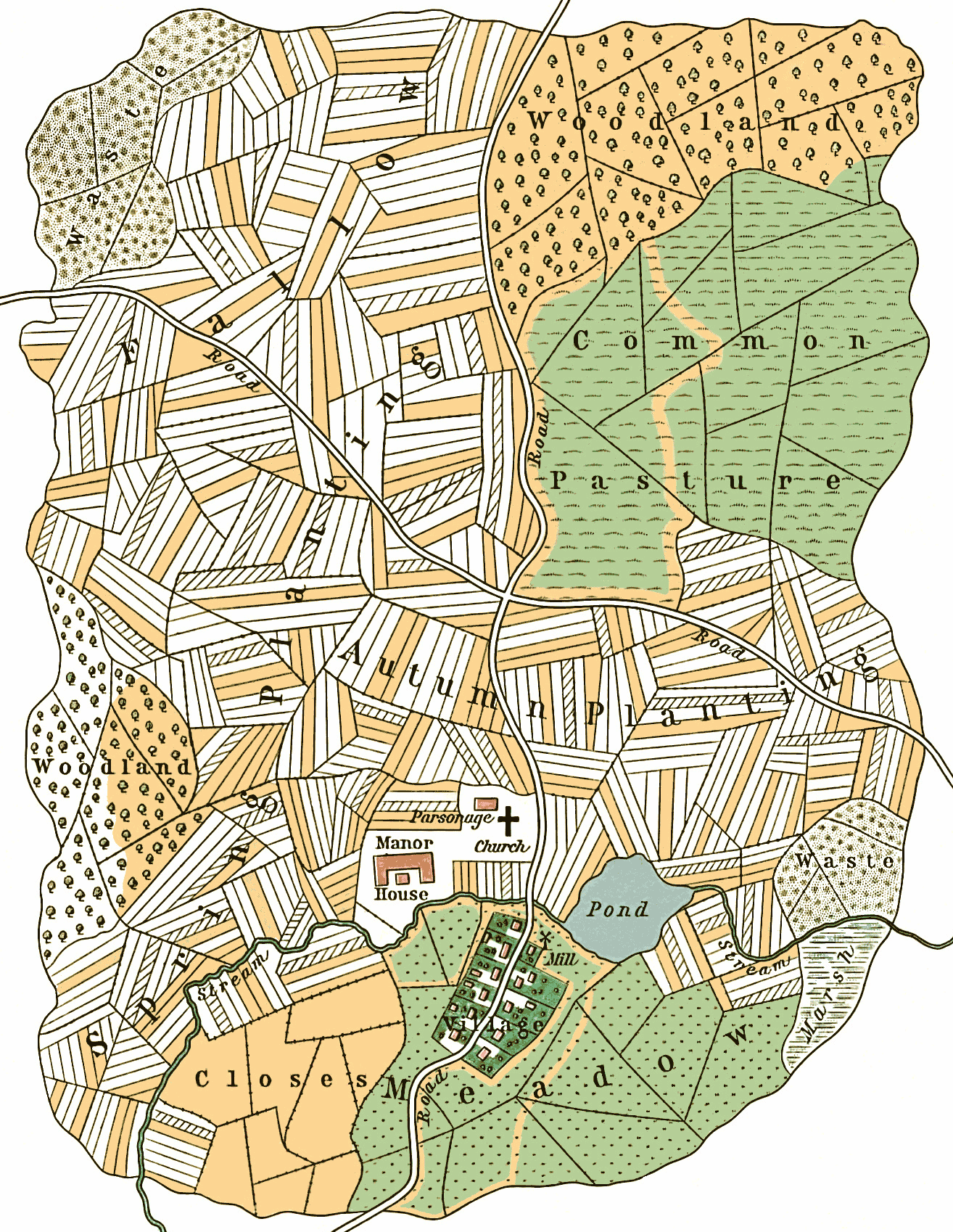
As you can see, the mansion or castle was built in close proximity to the village with no agricultural land in-between. Can you guess the reason for this?
The agricultural land used the “open-field system”. The fields were divided into long thin strips of land called “selions” (as pictured). Selions were separated only by ridges of unplowed turf, not by fences or hedges, because selions were not truly necessary.
Each peasant family was allocated approximately 70 selions totaling about 20 acres (8 hectares) scattered around the fields. The size of one selion varied from ⅓ to ½ of an acre.
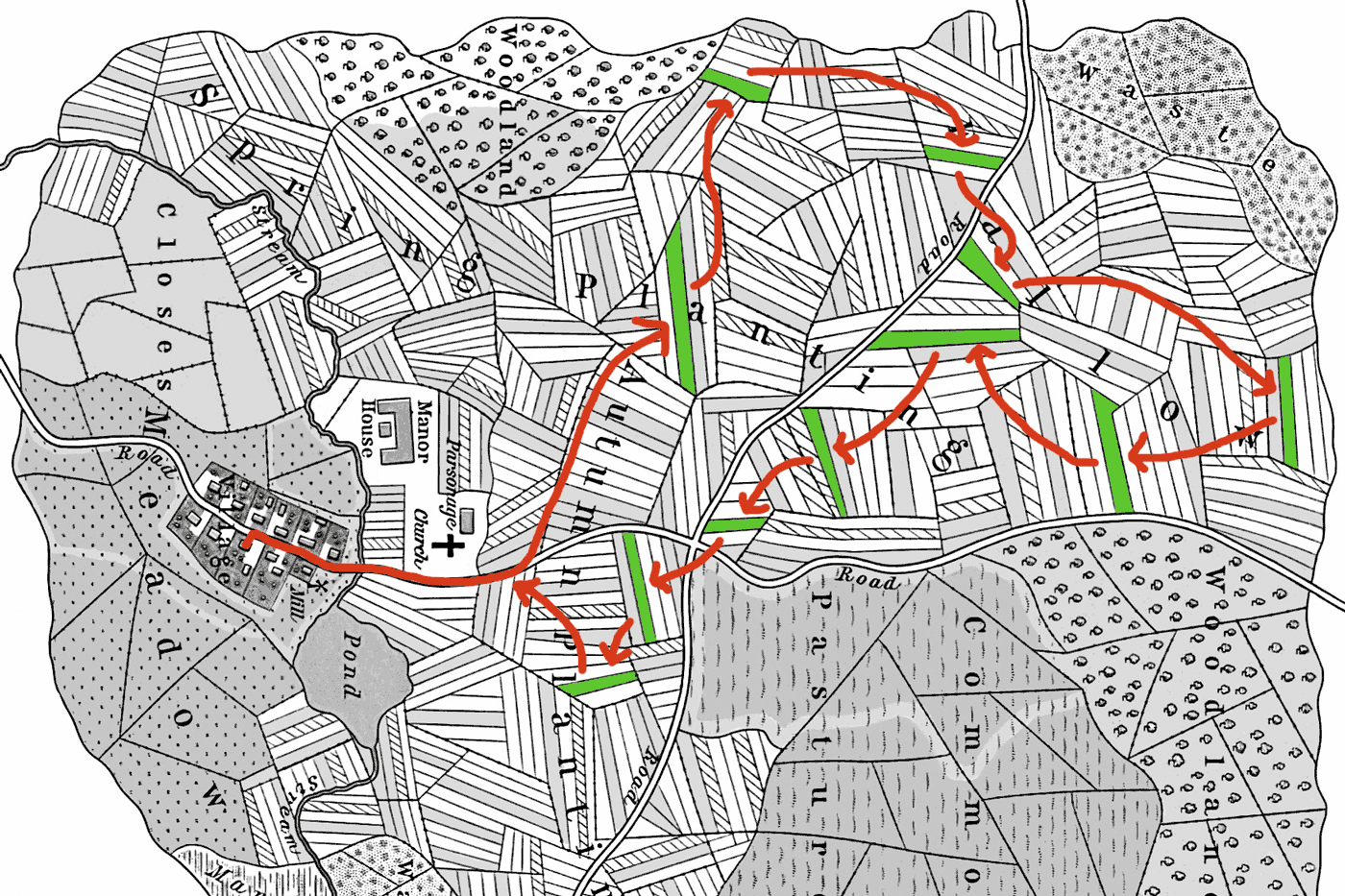
The deliberate scattering of the selions increased the time that a peasant needed to travel from his house in the village to each of his allocated selions. Many of the selions could be miles away. He was forced to walk a long distance to reach all of them and complete the required agricultural work in the selions.
Guess why the lord of the manor deliberately arranged the land in this inefficient manner. The most efficient arrangement would have been to keep all of a peasant’s allotted land together and to place the peasant’s house in the middle of this land. But the lord had other plans. Devious and disreputable plans.
The official excuse was that the land was divided into selions in order to ensure “fair” distribution of both good-quality and poor-quality land among the peasants. A lie is more believable when it is partially true.
If a peasant was allocated three or four pieces of land, then it could be credible to say that the reason is different soil qualities, but it is not credible to claim that the land needs to be divided into as many as 70 pieces. It was mostly a lie that was intended to consume the peasant’s time and keep him away from home for a longer time.
When he was away from home, his wife was left undefended and vulnerable at home while he was miles away working on the selions. The longer he was away each day, the easier it was for one of the noblemen or knights to seduce or rape his wife.
During the harvest time of year, the entire peasant family (including the children) was required to work in the fields until the harvest was completed, but at all other times of the year, the wife was a traditional housewife that mostly stayed at home and cared for the children (note that they had a larger number of children because of the lack of genuine and reliable contraception).
There were no police officers and no laws to prevent noblemen from seducing or raping peasant women. A bailiff existed, but he was employed by the lord of the manor, and the noblemen were mostly/practically immune from prosecution for crimes committed against peasants.
Similar to the so-called justice system in many countries nowadays, the medieval justice system strongly favored the upper class. In many or most cases, noblemen could rape peasants with impunity (with a few exceptions).
Nevertheless, most of the peasants admired the nobility as a result of their naivety and the tribal mechanisms in their brains (this behavior continues today to some degree).
In some manors, the village was located directly outside the forecourt of the mansion/castle, allowing the lord of the manor to simply walk out of his front door and fuck the prettiest women while their husbands were away for the day. In the above map, the manor has a little more privacy, and the noblemen and knights could walk a short distance from the manor to the women in the village.
You can also see in the map that the village was surrounded by a very large meadow. The “closes” (enclosures) were also nearby. The “closes” were private fenced-off areas of land, such as gardens, orchards, or paddocks. Thus a nobleman or knight had the option of fucking peasants in any of these convenient locations.
A nobleman could fuck the woman directly in her home (if her children did not disturb him too much), or he could request that she accompany him on “a walk in the meadow” or a walk in a garden or orchard in the “closes”. The woodlands were not used for breeding peasants, rather they were reserved for hunting, therefore it was not necessary to locate them adjacent to the village.
Thus the layout of a manor was designed to maximize sexual opportunities for the upper-class men at the expense of the majority of men (the peasants / the working class).
Occasionally the knights used violence to enforce the feudal system, but violence was usually unnecessary, because the majority of the peasants were willing to sacrifice themselves for the benefit of the upper class. Many people even voluntarily applied to become a serf and relinquish their freedom.
The clergy assisted noblemen with sexual exploitation
The peasants were pressured into attending the church in order to be indoctrinated every Sunday. In manors across Europe, the priests indoctrinated peasants to obey sexual rules that strongly favored the upper class.
For the upper-class men, the ideal arrangement would have been to somehow cause the lower-class (working-class) men to never have sex with any of the women, so that the upper-class men could monopolize all of the women in the entire manor and village.
However, such perfection was too difficult to obtain, so the noblemen settled for the lesser option of indoctrinating the lower-class (working-class) men to believe that they should rarely have sex with their wives.
The priests made many rules that all had the same goal of minimizing the amount of sex that the lower-class men had. The men were forbidden from having sex with their own wives at all of the following times:
Sundays.
Wednesdays
Fridays.
When men were required to work in the fields.
During harvest time, when the whole family was required to work.
Holy days such as the feast days of the “saints”.
Periods of holy fasting such as “Lent” and “Advent”.
During the pagan festival of “Easter”.
During menstruation.
During pregnancy.
During the first 40 days after giving birth.
While nursing/breastfeeding a baby.
During daylight / before nightfall.
When not fully naked (regardless of how cold the house was).
When seeking pleasure instead of “procreation”.
When not “married”.
When unfaithful.
During “penance” for “sins” allegedly committed.
On a day when they already had sex.
The religious rules varied over time and in different places. Some priests forbade the peasants from having sex on most days of the year (forbidden on more than 250 days per year). In some manors, only two to five days per month were left for married couples to have sex, and only if work obligations did not get in the way.
With such extreme restrictions, the lower-class men had little opportunity to have sex with their own wives if they were stupid enough or naive enough to obey the priest. Most of them were too stupid, naive, or gullible to recognize that they were being manipulated and exploited. Even when they did realize it, they often suppressed their own knowledge of it as a result of the tribal mechanisms in their brains.
When the peasants did manage to find a time when they were allowed to have sex, the clergy ensured that it was the least amount of fun as possible. The priests advocated the following rules:
No doggy-style position.
No woman-on-top position.
No position other than “the missionary position” (the man-on-top position).
No oral sex.
Do not have sex more than once in the same day.
No pleasure allowed (getting pleasure/enjoyment from sex is “sinful”).
Sex is only permitted for the purpose of procreation and not pleasure.
No fondling.
No lewd kissing.
No affection.
No sex in any place other than the marital bed.
Practice sexual abstinence as much as possible.
Other arbitrary rules to restrict sexual activity.
Priests claimed that if peasants had sex too often or enjoyed it too much, then their marriage would degenerate and become illegitimate and “sinful” and possibly even annulled.
The clergy dictated that if a couple of peasants broke the rules and had sex when forbidden (such as on Sundays), and if the wife got pregnant, then the child would be considered to be a “bastard” the same as if the child was born out of wedlock.
The clergy filled peasants with fear in order to reduce their sexual activity in order to make women more available for the upper-class men to enjoy.
When a nobleman seduced a peasant woman, and she confessed to the priest and sought forgiveness for her “sins”, the priest gave her penance: For 12 months, she was forbidden from having sex with her husband. This served the purpose of making it easy for the same nobleman to seduce her again and again, each time resetting her penance back to the start of the 12 months.
Restriction of meat and hunting
The nobles deliberately crippled the peasants by restricting their diet and causing some degree of malnutrition that weakened their brain and body. The primary method of doing this was to restrict the supply of protein (in this case meat) and fruits from the enclosed orchards.
Fruits were a critical source of vitamin C when few other sources of this essential vitamin were available. Vitamin C deficiency causes major health problems such as scurvy.
In the map of the manor, you can see two woodlands. Every lord of the manor strictly forbade peasants to hunt in the woodlands (except if they obtained special permission as an exception). Severe penalties were imposed on peasants that killed wild animals on the lands owned by a lord.
Now imagine that you are one of the peasant women in the village, taking care of your children. Your husband barely even tries to have sex with you anymore, because he is weakened by protein deficiency and exhaustion from the hard work. In addition, he has lost half of his teeth and his gums bleed easily, because he has scurvy (vitamin C deficiency).
While your husband is away (slaving away in the fields for the nobles), a healthy and fit nobleman visits you. You think he looks good, especially in comparison to your sickly husband. You feel attracted to this nobleman, and it has been a long time since you last had sex. He seduces you easily. He also gives you meat, eggs, and fruit for you and your children.
The upper-class men got the first pick of the pretty girls
In many manors, the lord prohibited the peasants from marrying without obtaining his permission first. This gave the noblemen the ability to get the first pick of the prettiest girls.
If a peasant man wanted to marry a very pretty peasant girl, the lord simply refused to grant permission. In this manner, the lord gave the pretty girl to a nobleman or a knight instead of a peasant.
If a young woman wished to marry a peasant in a different manor, then she was not allowed to marry him and move to his manor unless she (or her father) paid a fee to the lord to “compensate” him for the loss of the peasants that she would produce in future when having children.
Likewise, if a peasant of either gender wished to permanently leave the manor for any reason, then he/she was not allowed to leave unless the lord granted permission. If he/she tried to leave without permission, then the lord’s knights would track down the escaped peasant and punish him/her severely.
The medieval definition of consensual sex versus rape
Medieval laws tended to equate pleasure with consent. In their view, whether a peasant woman said “yes” or “no” was unimportant or irrelevant in determining consent to sex and impregnation.
If she verbally disagreed, and then the nobleman proceeded anyway, and then she appeared to feel pleasure during the sex, then it was considered to be consensual sex and not rape, especially if she had an orgasm, and even more so if she got pregnant in addition to having an orgasm.
Various medieval Christian writers claimed that a woman can only become pregnant if she has pleasure and an orgasm. Consequently, the sexual satisfaction of women was viewed as important. However, this belief also led to a malicious belief that if a woman was impregnated, then she must have enjoyed it, and it could not have been rape.
This definition of consent was beneficial for upper-class men, because it legally permitted them to rape a peasant woman by forcing her to experience pleasure and/or an orgasm against her will.
In reality, it is normally a disturbing and traumatic experience for a woman when she is forced to experience unwanted pleasure (pleasurable physical sensations), especially the intense pleasure of an orgasm. It is also traumatic when she is forcibly impregnated by a man that she dislikes (or a man that she does not want to be the father of her child).
Different women have different degrees of control over their orgasm. In my case, if I have an orgasm, then it most likely does indicate consensual sex, because I never orgasm during the man-on-top or doggy-style positions even if I think the sex is immensely enjoyable. I have an orgasm only when I really want it, and only when I do things to make it happen.
However, humans have much diversity. It is a known fact that some percentage of women can be forced to orgasm against their will while being raped. A woman’s orgasm is not proof of her consent to sex.
Likewise, vaginal lubrication is definitely not evidence of consent, because it occurs automatically without conscious thought. Some women have difficulty becoming wet even when they have enthusiastically decided that they greatly wish to have sex. Starting or stopping lubrication is not something that a woman consciously controls.
Pleasurable physical sensations are not the same as enjoyment. The medieval laws focused on pleasure, whereas enjoyment would have been a more accurate indication.
You can imagine a scenario where a woman is clearly exhibiting multiple signs of obvious and enthusiastic enjoyment of sex. It seems implausible that the sex could be rape when the woman exclaims blissfully during the sex, “So good!”, “Harder!”, “Faster!”, and then after the sex finishes, she smiles and says, “That was great. I enjoyed that a lot. Best sex ever!”
In many cases, noblemen probably did obtain consent from married peasant women, especially when a nobleman made an effort to make sex/adultery enjoyable for the various peasant women that he fucked, because he wanted to avoid being accused of rape. However in many other cases, upper-class men raped lower-class women (both married and unmarried women) during the thousand years of manorialism in Europe.
The reversed direction of rank was treated completely differently. If a lower-class man initiated sex with an upper-class woman, then it was almost always treated as rape regardless of how the woman reacted (even if she said, “Yes please!”), and the lower-class man was severely punished.
Women that happily co-operated with horny noblemen
It was not always rape. It depended on the personality of each particular man. A violence-loving knight may have violently raped many peasant women. In contrast, a different upper-class man may have seduced many women and obtained their consent and never raped a woman in his whole life.
A very handsome or attractive man is unlikely to ever engage in rape, because he has no need for it, because many women are happy to have sex with him. However exceptions always exist (for example, a sadistic man could engage in rape even if he has no need for it).
Upper-class men had a higher probability of being attractive for multiple reasons:
They did not suffer from malnutrition, because they took the best food for themselves and gave the inferior/incomplete food to the peasants.
They drank from a cleaner water supply than the peasants.
They were less likely to be retarded or deformed from Fetal Alcohol Syndrome (mothers drinking alcohol during pregnancy).
They had far more time to improve and enhance themselves, because they were not required to work.
They had much more money than peasants, thus they could purchase attractive things such as good clothing, an impressive sword, a horse, etc.
Their higher social ranking was also an attractive attribute.
Genetic selection: Over time, the appearance of the upper-class people gradually improved as a result of the upper-class men constantly choosing good-looking women to be their wives.
If a woman formed the opinion that a nobleman was much more attractive and healthier than her husband, then she may have been easily persuaded to agree to have sex with the nobleman, or she may have felt unmotivated to make any resistance, objection, or complaint.
Some percentage of peasant women undoubtedly enjoyed getting impregnated by upper-class men when the woman’s brain subconsciously formed the opinion that the upper-class man would give her children higher-quality genes. Many women voluntarily co-operated with horny noblemen when it benefitted the women and their children.
In most cases, a peasant husband had no way of knowing that he had been cuckolded, and that he was not the father of most of his wife’s children. However, even if he did discover it, he was forced to accept it anyway, because he was powerless.
Furthermore, the clergy forbade peasant men to divorce their wives regardless of how many times cuckoldry occurred. Lower-class men were forced to support the children of upper-class men.
Loyalty varies greatly between different women depending on:
Which type of sexuality she has (for example, whether she inherited the dual-mating strategy).
Personality differences.
Whether the husband fucks his wife in a manner that makes her feel sexually satisfied/fulfilled.
Some percentage of women undoubtedly sought to have sex with upper-class men deliberately, especially during the fertile phase of their menstrual cycle. Such a woman chose an upper-class man and then signalled her sexual interest to him in one of the following ways:
Letting her hair down. Married women kept their hair tied up in braids. Single women (or women wanting sex) allowed their hair to fall freely over their bodies, signalling that they were available.
Staring directly at her chosen nobleman.
Smiling at her chosen nobleman.
Lifting up her gown to expose her thigh.
Bending over in front of her chosen nobleman.
The genetic consequences of manorialism
The thousand years of manorialism in Europe caused:
An increase in the frequency of beautiful European women (as a result of the upper-class men seeking sex with the prettiest of the enslaved peasant women).
An increase in the frequency of intelligent people and/or the average intelligence of the populace (as a result of male dummies being cuckolded and having no children).
An increase in the frequency of psychopaths and sociopaths (as a result of psychopaths and sociopaths raping and impregnating many of the enslaved peasant women).
The North American version of manorialism
In the year 1865, the 13th Amendment to the United States Constitution abolished slavery and involuntary servitude in the USA.
Prior to 1865, white plantation owners and their sons and overseers frequently raped the many African women that they had enslaved. The widespread practice of raping slaves produced many descendants of mixed ancestry. (Reference: The section “Slavery” in the book “Encyclopedia of Rape”, edited by Merril D. Smith, August 2004, ISBN 978-0313326875.)
Thomas Jefferson (the third president of the USA from 1801 to 1809) was reported to have fathered six children with his slave Sally Hemings. She was 75% white and 25% African.
Under the law in Virginia at the time, being born to an enslaved mother made the children automatically enslaved from birth. Likewise in Europe, the children of peasants/serfs were automatically enslaved from birth (prior to 1789).
79% of African Americans in the USA have at least 12.5% European ancestry, and 19.6% have at least 25% European ancestry, according to genetic studies published in the book “In Search of Our Roots” by Henry Louis Gates Jr. (2009) and in a documentary series shown on PBS in 2008.
The rest of this article
The topics covered in the remaining half of this article include:
The wild side-effects of forbidding doggy-style position.
The advantages/benefits of doggy-style position.
Why & how lower-class women had intense sexual desire and “animalistic urges”.
How noblemen gave married women more enjoyment than their husbands did.
Why & how married women switched their loyalty to upper-class men.
The effect of multiple upper-class men fucking the same peasant woman.
Clothing designed for easy access and sex outdoors.
My strategy for survival in the medieval period.
Transactional sex and deal-making between men and women.
Conclusions and insights gained.