
The lunacy of colonizing other planets
How to colonize space without the suicide missions and delusional stupidity.
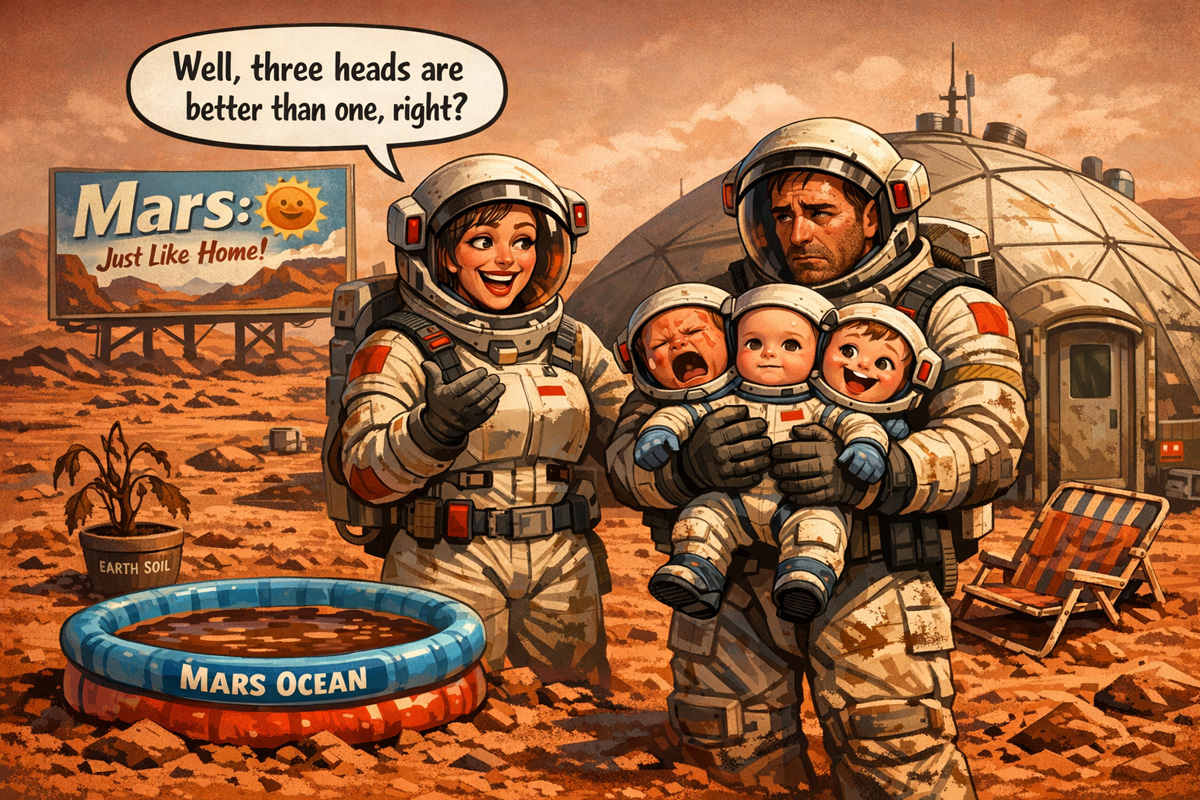
It is possible for a large number of humans to live outside of Earth permanently, but Mars is not the solution unless you like three-headed babies.
☠️ The reasons for not even trying to colonize Mars
In recent years, there has been increasing talk about colonizing Mars within a decade or two. This is an exciting-but-absurd idea.
As some scientists have pointed out, the gravity on Mars is only one third as strong as the gravity on Earth. The weak Martian gravity would be fun initially – imagine being able to jump three times as high, but it would not be fun anymore when the low gravity gives you serious medical problems such as osteoporosis (weak breakable bones) and heart/cardiovascular disturbances like what happened to astronauts when they spent too much time in the low gravity environment of the international space station.
On the other hand, who cares about your bones breaking when you're going to quickly die of cancer anyway? Radiation causes cancer and genetic mutations. The natural radiation on the surface of Mars is 40-50 times stronger than on Earth, so living on Mars is like trying to live in the aftermath of a worldwide nuclear holocaust. Not bad if you want your children to have three heads.
Why is the radiation so high on Mars? See, the Earth's core is full of molten iron swirling around in a way that creates a kind of giant magnet, and it causes Earth to be surrounded by a magnetic field called the magnetosphere. Earth's magnetosphere repels a lot of dangerous radiation coming from space.
So, does Mars have a magnetosphere to protect it from radiation? Well, it did, but that was 4 billion years ago, and then it broke down. So, Mars has no magnetosphere anymore to protect it from cosmic radiation. Hello, three-headed babies. Three heads are better than one, right?
Well actually, three heads are not necessarily better than one if the three heads “explode” as a result of very low air pressure. See, on Earth the air pressure is 101 kilopascals whereas on Mars it is less than 1 kilopascal (practically nothing). Yes, you read that right – the air on Mars is so extremely thin that even if you could magically pump one hundred times as much air into the Martian atmosphere, it would still be thinner than Earth's atmosphere.
So, you know that if you go very far underwater, the pressure crushes your body, and you die. In the opposite direction, if the pressure is extremely low like in space or on the surface of Mars, then obviously the opposite of crushing occurs. Either way, crushed or the opposite of crushed, it's not a pretty sight to look at.
Mars enthusiasts say:
“Don't worry about all that. We'll develop terraforming technology, and then everything will be all hunky-dory.”
If you want to terraform Mars to increase its gravity to the same strength as Earth's gravity, how much extra rock would you need to spread all over the surface of Mars? The answer is 6.3 quintillion tons.
How much rock is that? Well, if you take Earth's moon and smash it into Mars and then use an army of mega-bulldozers to evenly spread the moon-rubble all over the surface of Mars, and then if you search our solar system to find 700 more moons of the same mass as Earth's moon, then after you have finished smashing these 700 moons into Mars and bulldozing it all smoothly, then yes, then you would have successfully increased the gravity on Mars to the same as Earth, and then you could have a nice thick atmosphere with good air pressure like on Earth.
Oh but wait, to prevent all the three-headed babies, we also need to create a magnetosphere on Mars just like on Earth. Terraforming, right? Sure, why not? So, to complete our terraforming of Mars, we simply need to hollow out the core of Mars and fill it with magnetic molten iron just like Earth's core.
So, how much iron do we need to ship to Mars to give it an iron core the same as Earth? Well, it's not much, really. It's only one hundred quintillion (100,000,000,000,000,000,000) tons of iron and nickel.
So, when should we get started? Next year perhaps? The sooner we start, the sooner we finish transporting the 700 moons and 100,000,000,000,000,000,000 tons of iron to Mars. Heck, maybe we should start this year already, because you know, it's going to take a billion years or so to finish terraforming Mars to make it suitable for humans, and we don't want to delay this project any longer. Let's get a move on! Chop, chop, chop!
Wait, wait, wait, we nearly forgot to mention that there is another problem: There is no soil on Mars! Instead of soil, there is toxic sand and dust. Martian sand/dust contains 0.6% perchlorate – this is an amount of chlorine that is lethal to life. A study in 2017 described it as follows:
“Mars is highly deleterious to cells, caused by a toxic cocktail of oxidants, iron oxides, perchlorates and UV irradiation.”
So, let's add that to the plan, shall we? We need a giant vacuum cleaner to suck up all the sand/dust all over the surface of Mars, and then we need to replace it with billions of tons of actual soil transported to Mars from Earth. Another item for the “To Do” list then?
🪐 What about colonizing other planets?
Other planets have the same problem as Mars – variations of insurmountable lethal environmental conditions. The only planet that is not lethal to humans is Earth. The probability of finding a suitable Earth-like planet in our galaxy is very low. There surely exists an Earth-like planet somewhere in the galaxy, but it is too difficult to find, and too far away to travel to (for example, a hundred thousand years away).
It is unrealistic to think that biological humans will ever colonize any other planets.
🛠️ The solution: Toroidal space stations
I discussed this with my friends. We think that the only practical solution for the colonization of space is to forget about planets and instead build large toroidal space stations and/or spaceships.
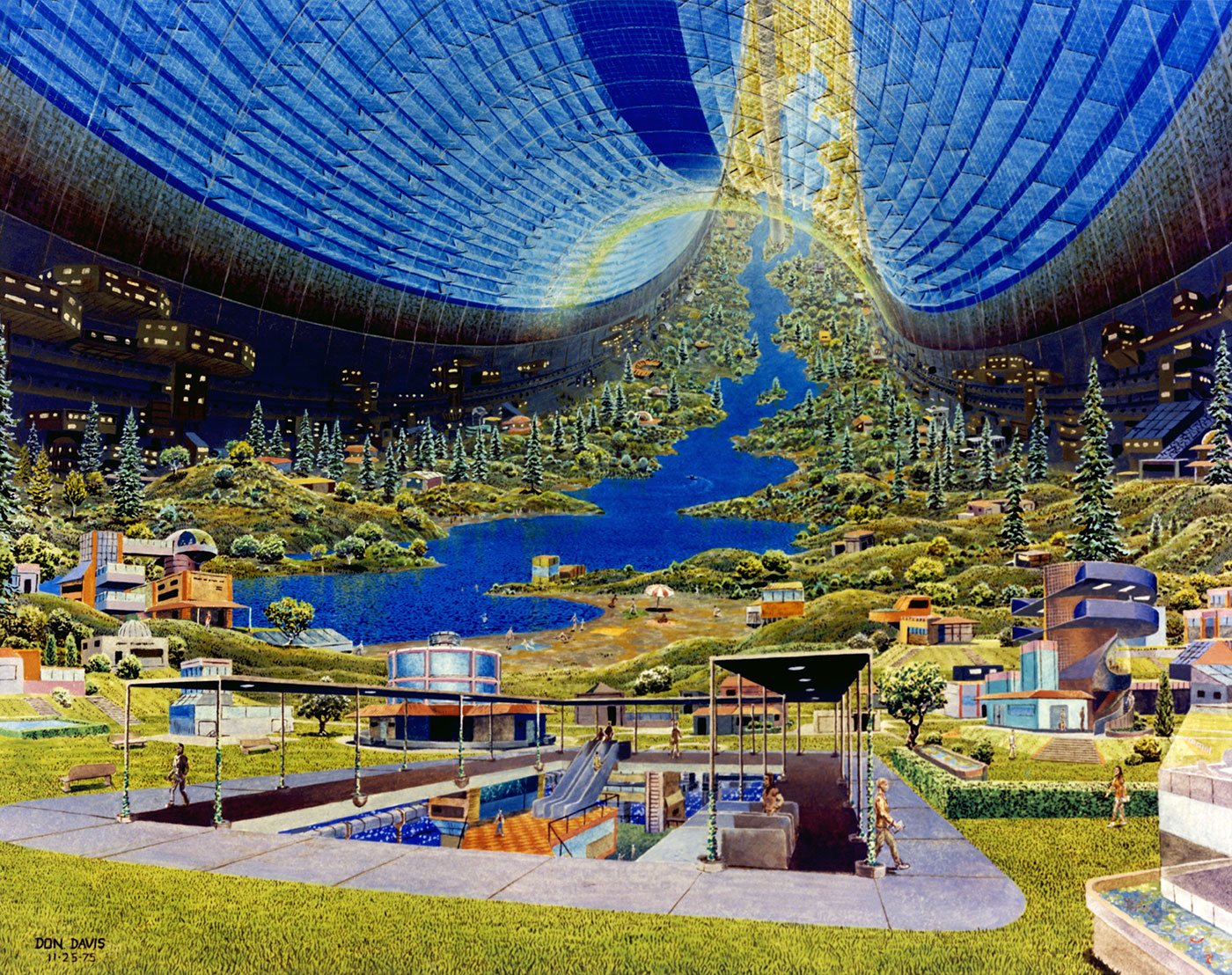
In 1977, NASA and Stanford University published a proposed design for a space station called “the Stanford torus”. It is large enough for 10 thousand people. It consists of a torus (a hollow circular tube) that is nearly two kilometers in diameter. It rotates once per minute to generate artificial gravity with the same strength as Earth's gravity.
The artificial gravity is actually centrifugal force, therefore people would be able to walk normally on the inside of the outer ring like shown in this painting:
To construct the Stanford torus, approximately 10 million tons of material would be required. It is impractical to transport 10 million tons from Earth into space. Therefore, a better idea is to build the torus inside a large asteroid. Instead of building a fragile scary torus out of sheet metal, excavate a rock-solid torus inside a rocky or metallic asteroid.
There are multiple advantages of having the space station inside a rocky asteroid:
The surrounding rock would shield the space station from the dangerous radiation in space.
The surrounding rock would shield the space station from impacts from high-speed debris and small asteroids (and potentially weapons in the event of war/terrorism).
The surrounding rock makes it easier and safer to maintain Earth-like air pressure inside the space station without the risk of explosive decompression.
The surrounding rock provides excellent thermal insulation, making it practical to maintain the internal space station at a comfortable temperature.
Terraforming a planet is an extremely far-fetched idea that is unlikely to ever happen. In contrast, a toroidal space station is not far-fetched and could be constructed in reality (if we do not exterminate our species first via global heating and insane wars).